
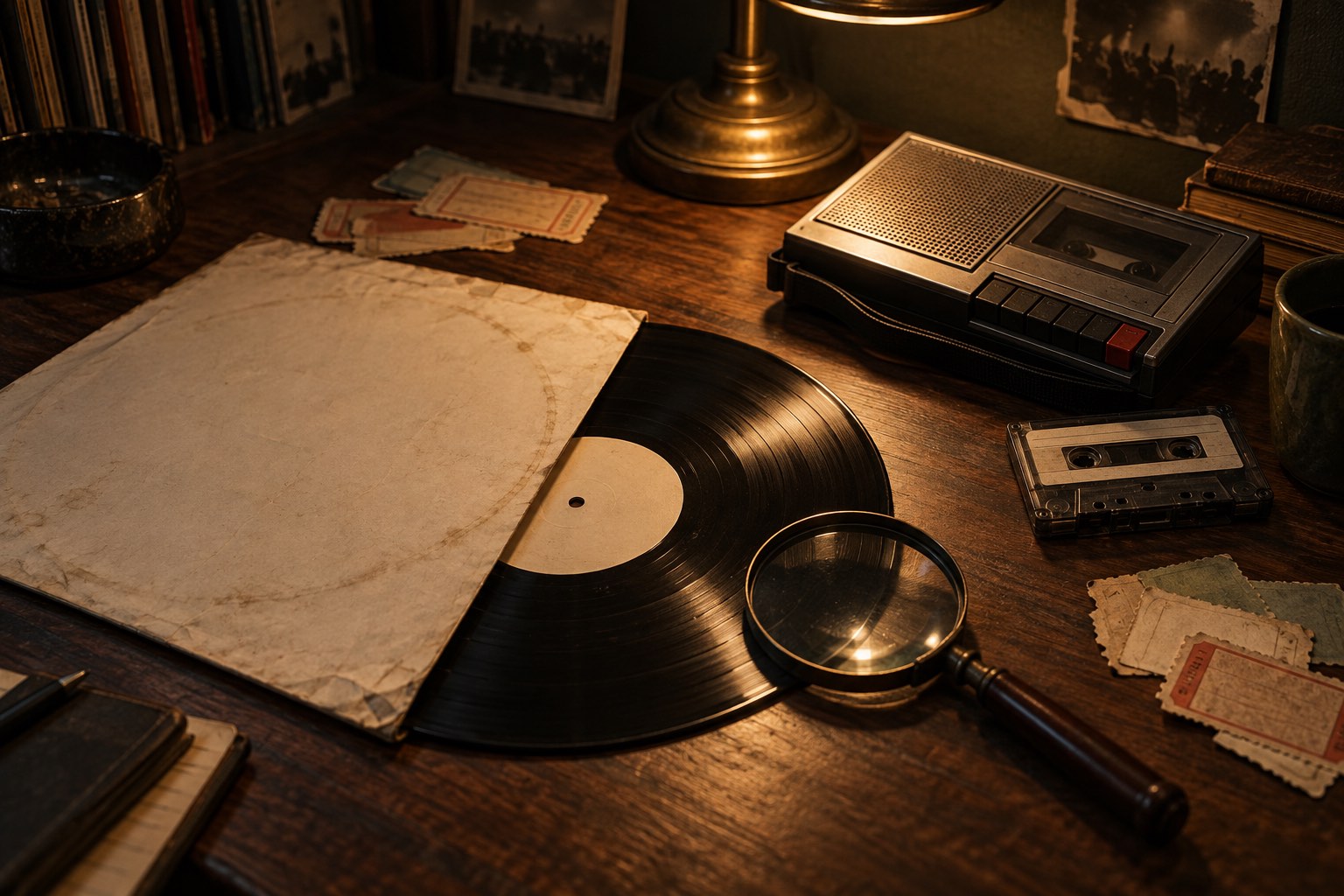
How do you identify a vinyl bootleg? Start with the music, not the sleeve: if the record carries a concert, rehearsal or outtake that the artist’s label never issued, and no real label or rights holder stands behind it, you are most likely holding a bootleg. Then confirm it with the label credits, the runout markings and a database entry such as Discogs, which files these records as Unofficial Release.
A plain or rubber-stamped sleeve is a clue, not proof. The checks below take a few minutes at a record shop, and the rest of this guide explains where they come from.
How to identify a bootleg record: five checks
- Check the official discography. Is this performance, rehearsal or outtake available on any authorised release? Material that never came out officially is the classic sign of a bootleg. Be careful with titles: Bob Dylan’s The Bootleg Series is official, despite its name.
- Read the label and the credits. Look for a label you can trace, a catalogue number that fits that label’s numbering, and copyright or rights-society lines. Bootleggers often invented label names or left them out. A 1974 Pink Floyd bootleg, Brain Damage, credited the “Screaming Abadabs”, one of the band’s early names.
- Look at the packaging, but don’t stop there. The first rock bootlegs came in plain sleeves with rubber-stamped titles or a paper insert. Within a few years some bootleggers were printing full picture covers, so a professional sleeve does not make a record official.
- Listen to the source. An audience recording, taped from the crowd, has room sound, crowd noise and a distant band. A soundboard recording, taken from the mixing desk, is cleaner but can have an odd instrument balance. This tells you where the tape came from, not whether the release was authorised.
- Match the runout and the database. Photograph the matrix and runout markings on both sides and compare them with the documented pressings. On Discogs, look for the Unofficial Release format description, and read the notes and submissions behind it. Our guide to catalogue numbers and matrix codes shows where to look.
If the record copies an official album, down to its artwork and catalogue number, you are dealing with a counterfeit rather than a bootleg. Blurry printing from scanned artwork and runouts that match no official pressing are typical warnings. Our counterfeit checklist walks through that case step by step.
Bootleg, counterfeit or pirate?
Collectors use these words loosely, but they describe different things:
| Term | What it contains | What it tries to look like |
|---|---|---|
| Bootleg | Unreleased material: live shows, rehearsals, outtakes, broadcasts | Its own release, often with a vague or invented label |
| Counterfeit | A copy of an official release | The official record, as closely as possible |
| Pirate | An unauthorised copy of an official recording | Usually does not hide that it is a different product |
Discogs groups all of these under Unofficial Release. See its format guidelines.
I find three questions more useful than judging a sleeve: What was recorded? Who released it? Was permission given? Plain packaging alone proves little, and polished printing cannot establish authorisation.
Where vinyl bootlegs began: 1969
The first notable rock bootleg is Bob Dylan’s Great White Wonder, which appeared in southern California around July 1969. It was compiled from a 1961 home recording made in Minneapolis, early radio and TV material, studio outtakes and songs from the Basement Tapes sessions, and it took its nickname from its plain white sleeve. It was produced by Ken Douglas and Michael “Dub” Taylor, who went on to run the bootleg label Trademark of Quality, known by its cigar-smoking pig logo. Background
TMOQ is a useful reference for how bootleg packaging changed. Its early albums had blank generic jackets with rubber-stamped titles and coloured stickers, pressed on black or coloured vinyl. From 1973, artist William Stout drew cartoon covers for many of its releases. Label history
Bob Dylan’s website documents the later official archival collection The Basement Tapes Complete. The circulation history of the music and the identity of a particular pressing are distinct questions. Official account
A few months after Great White Wonder came Live’r Than You’ll Ever Be, taped from the audience at the Rolling Stones’ Oakland concert on 9 November 1969. It was one of the first live rock bootlegs, and its popularity is widely credited with prompting the band’s labels to release the official live album Get Yer Ya-Ya’s Out! in 1970. Background
Why I started looking into bootlegs
A collector’s guide to bootlegs? Reading this post, the question that caught my attention was not which record costs more. It was why someone would spend hours studying a record with a barely decorated sleeve.
The post mentions references such as Hot Wacks. That was a Canadian bootleg guide by Kurt Glemser, published in Kitchener, Ontario, from 1975 and running to fifteen books; collectors called it the “bootleg bible”. Background The need behind guides like that is comparison: when several editions circulate of the same performance, listeners need notes they can check against one another.
If I were compiling a guide, I would begin with the opening, track order, applause edits and completeness of a particular solo. Then I would describe the physical edition, packaging and condition. Those comparisons help answer why this particular version is worth hearing.
Rarity and personal relevance are separate judgments. A recording important to someone studying a tour may not suit a listener who simply wants an uninterrupted album.
Another story: listeners making recordings
The Grateful Dead’s official archive describes the development of fan taping and trading. It offers a picture of musical memory preserved by audiences, beyond the studio album. Taping history
Understanding that culture does not answer the permission question for every artist. I would record any available permission statement separately, rather than treating “fan-made” as a universal answer.
An extraordinary detour: music on X-ray film
The X-Ray Audio project documents Soviet-era “bone music”: restricted music carried on X-ray film. These objects bring together sound, materials and the circumstances of everyday life. Archive and authentic examples
They are not ordinary PVC vinyl records. They belong in this discussion because they raise a related question: what have people been willing to devise just to hear a song? Our cover is a modern illustrative scene, not a generated image presented as a historical artifact.
Bootleggers welcomed by the band
King Gizzard & The Lizard Wizard’s Bootlegger project provides selected recordings and assets for fan releases under published conditions. Polygondwanaland is a well-known example. Check the individual terms; one project’s permission does not extend to the band’s entire catalogue. Official Bootlegger page
What interests me here is the listener becoming a participant in a release’s design. It also makes permission worth documenting in its own right, beyond a simple official/unofficial label.
What to write down for each edition
This is a set of notes I would keep at a record shop or while organizing a collection, rather than a price ranking:
- Recording: date, venue and track order. Mark uncertain performance details as unverified.
- Edition: catalogue number, labels, sleeve details and photographs of matrix/runout markings near the centre of the record.
- Listening: audience or soundboard source, distortion, edits and playback noise. Record the disc’s condition separately from the character of the recording.
- Evidence: distinguish sleeve information, database research and seller descriptions. Keep links and the date checked.
- Personal reason: a particular performance, a different arrangement or the design? One sentence can help you rediscover its appeal later.
A database entry is not permission to trade. Discogs distinguishes documentation from marketplace availability and restricts sales of unauthorized bootlegs and other releases. Marketplace policy
An unusual label can also indicate a promotional copy. Our mihonban guide explains how to approach Japanese sample records without confusing them with unofficial releases.
Further reading
- Clinton Heylin, Bootleg: The Secret History of the Other Recording Industry (St. Martin’s Press, 1995). A history of the bootleg trade from its start in southern California in 1969, with much on Dylan, the Rolling Stones, Led Zeppelin, Springsteen and the Beatles.
- Lee Marshall, Bootlegging: Romanticism and Copyright in the Music Industry (SAGE, 2005). The first full-length academic study of bootlegs, looking at why collectors want them and how the record industry and copyright law respond.
- Stephen Coates (ed.), X-Ray Audio: The Strange Story of Soviet Music on the Bone (Strange Attractor Press, 2015). The story of Soviet X-ray records and the people who made and bought them, with photographs of the discs.
- Kurt Glemser, Hot Wacks. The collectors’ reference guide mentioned above. It is long out of print, so look for second-hand copies.
What are we collecting, really?
For me, this subject pushes curiosity beyond the cover: who made these sounds, on which day, and what happened in that moment?
As you organize your vinyl collection with CRATTO, bring that question back to the shelf. More than remembering that a record is scarce, I want to remember why I could not put it down.