
A long-awaited record finally appears on the shelf: the cover looks familiar, the price is acceptable, and the seller says it's a rare version. What really makes you hesitate is often a small question before payment—how do I know its origin?
To identify a suspected counterfeit vinyl, the practical starting point is to verify the specific version. Put the cover, label, catalog number, and runout etchings on both sides together, then compare them with release data. A single matching detail only adds one clue; if contradictions arise, you should continue to verify. The following process is a purchasing verification suggestion compiled from the sources at the end of this article, not a certification for any specific item.
First, Distinguish: Which Kind of "Counterfeit" Are You Worried About?
In everyday conversation, "counterfeit" covers several different situations. Discogs' format guidelines provide approximate definitions: Bootleg refers to unauthorized recordings of live or broadcast performances; Counterfeit refers to unauthorized copies or releases whose packaging imitates the original as closely as possible; Pirate also involves unauthorized copying or release, but the packaging is usually different from the original. [1]
This article mainly discusses replica records that buyers easily mistake for official versions, and how to verify unofficial releases when purchasing. If you see a seller write "bootleg," it's best to ask further what exactly they mean. Platform labels also do not equal a rights verification for each individual item.
Step One: Ask the Seller for Information About This Specific Item
Don't just look at a single front cover photo. My advice is to request before payment: front and back covers and spine, labels on both A/B sides, runout etchings on both sides, and the release region, year, and version the seller claims.
Let photos answer specific questions; it's more effective than asking "is it authentic?" For example: "Can you clearly photograph the complete etchings on both sides? Which version page are you basing your judgment on that it is this version?"
The UK Intellectual Property Office advises buyers in its consumer reminder to pay attention to the seller's own photos of the actual item, historical feedback, and the record's provenance, and to be wary of the same seller having multiple long-out-of-print rare records. [4] These are purchasing risk clues. They are worth asking about, but they cannot alone determine the nature of a specific record.
Step Two: Find the Specific Release Version
It's recommended to start searching by artist, album title, and the physical catalog number, then narrow down item by item. Save links to candidate versions and note where they match and don't match the record in your hands.
Here's an easily overlooked issue: even if the record bears the name of a well-known label, it still needs verification. Discogs' label guidelines explicitly warn that counterfeit releases may use the original label and company names on their packaging. [3]
Therefore, I recommend treating the catalog number as a search entry point, not as proof that "if you find it, it's real." Continue examining label layout, tracklist, media specifications, and version notes; if the candidate page has no photos or incomplete information, keep your doubts and don't fill in a definite answer for it.
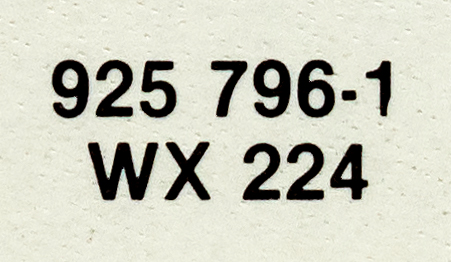
Example of a physical catalog number, used to illustrate the search information for step two; not a counterfeit case. Photo by W.carter, unmodified. Image source · CC BY-SA 4.0

Step Three: Check the Runout Etchings, Both A and B Sides
The area between the last track and the center label is often called the runout or dead wax. Discogs' identifier guidelines state that information here often appears as stamped or etched, and may include engineer, studio, or manufacturer information, as well as additional text. [2]
When verifying, it's recommended to transcribe the characters on both sides separately, preserving recognizable letters, numbers, and symbols, then compare with the candidate version. Photograph unclear areas clearly; don't fill in characters from imagination.
The same guidelines also allow a single version to record multiple runout variants. Therefore, if a character is missing or there's a slight difference, you should continue checking variant records rather than immediately declaring it fake. [2]
My verification principle is: if the etchings and packaging point to different versions, stop and investigate why; if all data currently matches, only write "consistent with the data for this version." Public images and text alone cannot provide an absolute guarantee for a physical item.
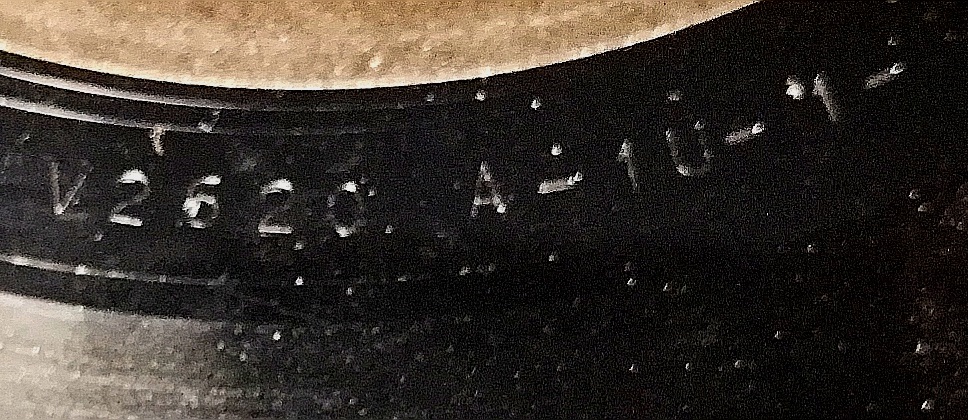
Example of physical runout etchings, corresponding to the inspection location in step three; not a counterfeit case, and not used to judge the authenticity of the record in the photo. Photo by Tashi, unmodified. Image source · CC BY-SA 4.0

Step Four: Treat Printing Issues as Clues, Not a Verdict
The UK Intellectual Property Office lists blurry, rough cover or label printing as a suspicious sign. [4] In actual verification, I recommend choosing details from the same candidate version for comparison: whether small text is clear, whether logo positions are consistent, and whether tracklist and numbers contradict each other.
Do not use any random album cover from the internet as the sole standard. What you need to prove is that the two belong to the same version, not that they use the same artwork.
Also, do not equate "missing label" directly with counterfeit. Discogs' Not On Label category also accommodates situations such as artist self-releases.[3] Sparse information means you need to dig one step further.
Step Five: Let the Evidence Decide Whether to Buy
After verification, you can leave yourself one of three records:
- Information largely matches: Write down the corresponding version link, photos, and any points still unverified.
- Contradictions exist: List the specific discrepancies and ask the seller for supplementary materials; hold off on purchasing until the explanation is sufficient.
- Insufficient information: Unable to confirm for now. For expensive records, continue to verify through the label, the artist's official channels, or a store familiar with that version.
This classification is the working method compiled in this article. There is no hundred-point scale, nor any guarantee that "meeting three criteria means it's genuine." Its purpose is to ensure judgments are documented and evidence-based, rather than being pushed into payment by words like "rare," "original," or "limited edition."
Common Questions
Can scanning a code prove authenticity?
Use scan results to find candidate information, then continue verifying the physical item. Query results show database records; they cannot replace verification of the record in your hands.
If it's not listed on Discogs, does that mean it's fake?
You cannot judge based on that alone. When you can't find it, the only conclusion you can write down for now is "no comparable information has been found yet." Continuing to look for official release information, or submitting clear photos to ask the community, is more valuable than hastily labeling it.
If one item doesn't match, should you give up?
First, specify exactly which item. The runout guide explicitly mentions variants,[2] while obvious conflicts between packaging numbers, etchings, and seller descriptions are worth further questioning. Do not explain away all differences as normal, nor treat all differences as forgery.
What is the single most worthwhile thing to do before buying?
Ask the seller to provide actual photos of both labels and the complete runout etchings, and to state which release version it corresponds to. This way, the discussion shifts from "trust me" to information that can be checked item by item.
The joy of collecting records also lies in these details: flipping through the sleeve, reading a line of small print, turning the record to look for etchings. Giving these steps a little time is often more useful than rushing to a conclusion about a record.
References
The following links are for verifying terminology, identification rules, and risk warnings; the operational procedures in the main text are editorial compilations and do not use fictional record cases. Information verification date: September 18, 2026.
- Discogs: Database Guidelines 6. Format, 6.15 Bootlegs, Pirates And Counterfeits—approximate definitions of terms.
- Discogs: Database Guidelines 5. Barcodes & Identifiers, 5.2.o Matrix (Runout)—runout identifiers, additional text, and variant records.
- Discogs: Database Guidelines 4. Label / Catalog Number, 4.4 and 4.6.1—no-label releases and counterfeit label markings.
- UK Intellectual Property Office: Spinning lies: the rise of fake vinyl and how industry is fighting back, April 10, 2025—risk warnings on print quality, seller records, physical photos, and supply of rare records. This article only adopts the above relevant warnings and does not directly use its checklist as an authentication standard applicable to all records.