
Recently I bought a Peabo Bryson album, Positive. I didn't pay attention when I bought it, but one day I took it out to play and noticed the label had the three characters 見本盤 printed on it, with "非売品" (not for sale) in the lower right corner. My curiosity got the better of me, and I systematically went through all the materials I could find. If you've also come across such a record while digging, you can compare notes.
First, the conclusion: sample records (見本盤) are promotional records that Japanese record companies gave to radio stations, critics, record stores, and media before release, and they were not sold to the public. They belong to the earliest pressings, so they are often said to have "better sound quality," but whether that's true for the copy in your hands can only be determined by comparing matrix codes and actually listening. They are fewer than retail copies, but prices vary widely: most are worth only a few hundred to a few thousand yen, while the expensive ones are often singles that only had promotional pressings, special vinyl colors, or popular works.
Quick Overview
- A sample record (見本盤, mihonban) is a "sample disc": Japanese record companies used it for promotion before release, and the label or sleeve often bears "見本盤," "非売品," or "SAMPLE."
- The practice of giving free records to radio DJs is often credited to America's Capitol Records, founded in 1942. In Japan, records marked "見本盤" and "非売品" existed by 1958 at the latest; by the 1970s, promotional records had become almost standard practice in Japan.
- Toshiba began pressing anti-static red vinyl records around 1958. For the Japanese edition of Pink Floyd's Ummagumma, only the sample record was on red vinyl; in August 2018, one copy sold on Discogs for $13,953.
- The reason "sample records sound better" is that they were pressed earlier and played less. But sample records could also have been worn out at radio stations, and the influence of the master tape and cutting is often greater, so you need to confirm by matrix inscriptions and listening.
- Sample records are fewer than retail copies and sometimes differ in content, such as mono versions. However, in the Japanese secondhand market, sample records are not rare, and their value depends on the specific edition and condition.
What Is a Sample Record?
A sample record (mihonban / 見本盤), literally meaning "sample disc," is a record made specifically by Japanese record companies for promotion. It was not sold in stores but sent before release to radio DJs, critics, record stores, and media to build buzz for new releases. Audio-Technica's record terminology resource also associates pre-release or promotional sample records with sample records and promotional discs.
You can think of it as the music industry's "internal trial sample." What's interesting is that it makes you ask one more question: where might this record have been sent originally? How does it differ from the version sold in stores? However, markings alone cannot fully reconstruct the complete chain of ownership of a particular record.
Where Do Sample Records Come From?
Starting with American Radio
The most frequently cited starting point for giving free new records to radio stations is America's Capitol Records. According to Wikipedia's Capitol Records entry, the company was founded in Los Angeles in 1942; on June 4 of that year, co-founder Glenn Wallichs gave the company's first free record to Los Angeles radio DJ Peter Potter. Later this became a regular practice in the record industry: sending promotional records to radio stations, DJs, and critics before release, hoping that airplay and reviews would drive purchases (see Wikipedia's "Promotional recording").
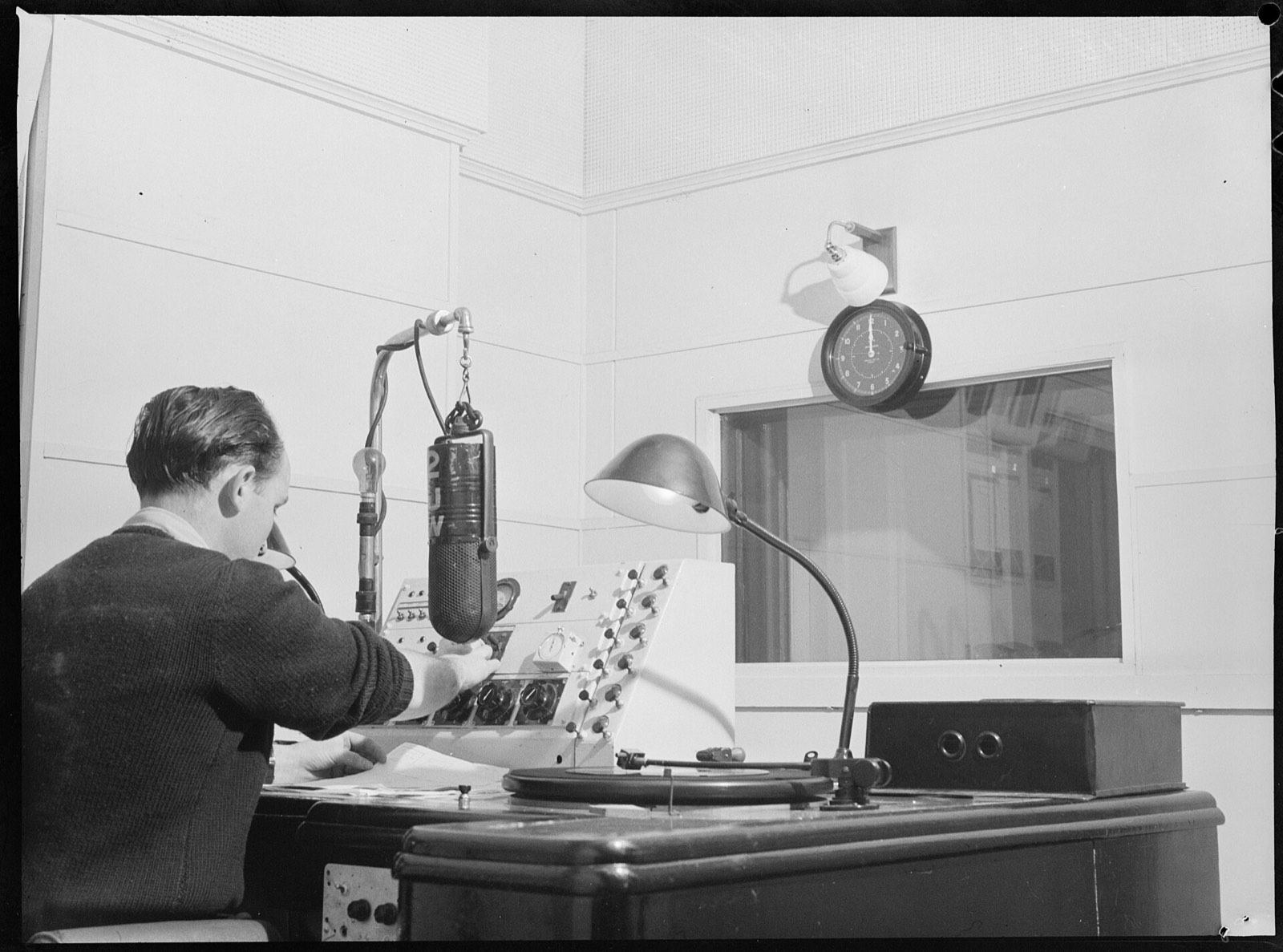
On August 18, 1949, a DJ at a Sydney, Australia radio station began the night shift. Record companies sent out promotional discs precisely in the hope that new records would be played on such broadcast desks.
Japan: Sample Records Existed in the 1950s
Japanese record companies also began making promotional records in the 1950s. Among records from 1958 listed on Discogs, Victor's Elvis Presley King Creole, Victor's Mendelssohn symphony record, and Nippon Columbia's Hibari Misora 78 rpm record 女ざむらい只今参上 all have "見本盤" and "非売品" printed on their labels. The Mendelssohn record didn't even have a sleeve, only two sheets of paper with the front and back cover.
However, in the 1950s and 1960s, promotional records were not yet numerous. Collecting references generally agree that by the 1970s, Japanese record production increased greatly, and promotional records became almost standard practice (see Plexus Records' introduction). Japanese records have long been known for quiet surfaces and careful pressing, and often include an obi strip outside the sleeve. The obi is not attached to the sleeve, and many buyers casually discard it, making promotional copies with obi even harder to find. For this part, you can refer to Why Japanese Pressings Are Sought After.

In 1954, a record store in Shin-Nakamise, Asakusa, Tokyo (photo by Takekuni Tanuma). Four years later, in 1958, Japan already had records printed with "見本盤" (promotional copy).
Toshiba's Red Records
Around 1958, Toshiba introduced a type of record mixed with an antistatic agent called "Ever Clean" to reduce dust attraction; because the disc surface was red, it was also called "red disc" (see Japanese Wikipedia "EMI Music Japan"). Red vinyl continued to be used until the early 1970s, and retail editions also used it, so red vinyl itself does not indicate a promotional copy.
However, some releases only had promotional copies on red vinyl. According to Discogs, the Japanese edition of Pink Floyd's Ummagumma (Odeon OP-8912-13, 1970, manufactured by Toshiba Musical Industries) used red vinyl only for promotional copies, while retail editions were all black vinyl. The Japanese edition of Elton John's Empty Sky (DJM FP-80051, 1970, also manufactured by Toshiba) also had red vinyl white-label promotional copies.
In August 2018, a Japanese red vinyl promotional copy of Ummagumma sold on Discogs for $13,953. Discogs confirmed to Digital Music News that this was the highest-priced music collectible sold on the platform that month.
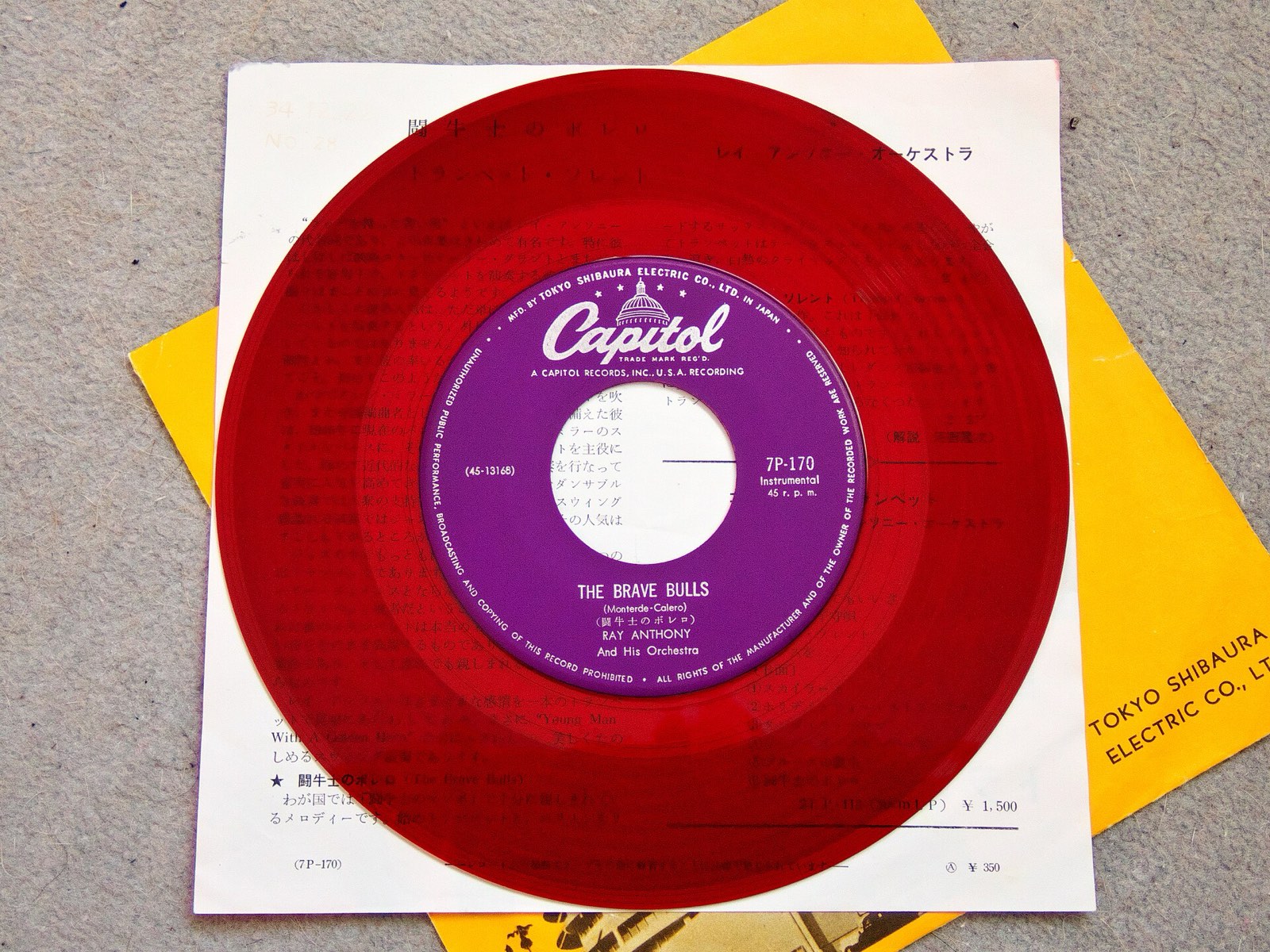
Toshiba-pressed red vinyl record: Ray Anthony "The Brave Bulls" (Capitol 7P-170). The label does not say promotional, and red vinyl was also used for retail editions.
1970s: White Labels and "Not for Sale"
In the 1970s, the appearance of promotional records gradually became standardized: white labels printed with "見本盤" or "非売品" (not for sale), some stamped; some labels also printed the release date, and promotional stickers were affixed to sleeves, though specifics varied by company. This practice continued into the 1980s. My 1988 Peabo Bryson (Elektra P-13620) has a label printed with "見本盤", the release date "2/25発売", and "非売品".
Promotional records were sent out before release, sometimes weeks or months in advance, so that radio stations could play them first and media could write about them, and record companies could gauge reaction (see Wikipedia "Promotional recording"). Some companies also made compilation albums that were given away, not sold, to introduce new records to radio stations and stores, such as Nippon Columbia's 1975 コロムビア洋楽ポピュラー10月新譜ダイジェスト and Warner-Pioneer's American Rock Sampler.
Promotional Records in the CD Era
Vinyl record production in Japan peaked in 1980. In October 1982, CDs began to be sold in Japan. According to the Japan Record Association (RIAJ) production statistics, in 1986 CD production (45.12 million units) surpassed LPs (42.75 million units), and in 1987 CD production value also exceeded the total of all vinyl records.
Sample/promo records changed formats along with it. CD promo records mostly had promo stickers affixed to the case or obi, or had words such as "見本品" (sample), "サンプル" (sample), or "SAMPLE" printed on the disc. For example, for a 1988 Toshiba EMI promotional CD, a sticker was affixed to the cardboard on the back of the case with white background and red text reading "見本(非売品)" (sample, not for sale); for another one by CBS/Sony in the same year, the transparent part of the disc center had "サンプル" printed on it.
Japan's charts look at sales
Japan's most influential Oricon chart has counted sales since 1968 (see the Wikipedia entry on Oricon). The US Billboard singles chart includes radio airplay in its rankings, whereas in Japan it was not until the 2008 appearance of Billboard Japan Hot 100 that there was a chart combining sales and radio airplay. So in Japan, the main function of sample/promo records was not to climb the charts, but to generate exposure, build reputation, and observe market reaction.
First look for markings, then verify the version
Pay attention to words such as "見本盤" (sample disc), "見本" (sample), "非売品" (not for sale), "SAMPLE," or promotional markings on the labels and sleeves. Photograph these details, then verify the catalog number (called "品番" in Japan), label design, tracklist, and the inscriptions in the runout groove (matrix codes). Also note whether the markings are printed, stamped, or later-applied stickers. For how to read catalog numbers and matrix codes, see Catalog Numbers and Matrix Codes.
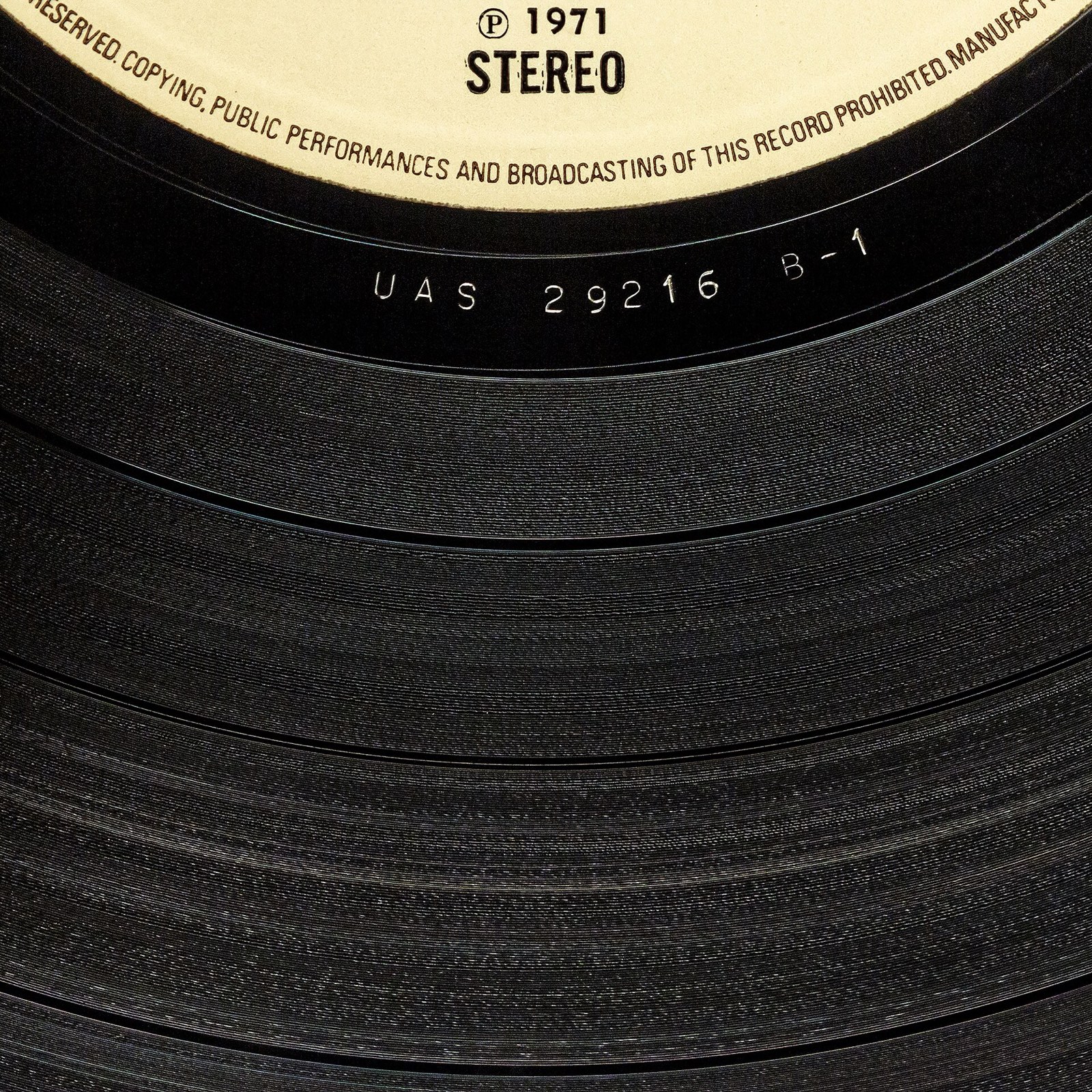
Runout matrix code in the runout groove (a 1971 United Artists LP). When comparing a promo record with a retail version, first photograph this ring.
A white label by itself is not enough to confirm identity. Discogs' format rules distinguish promotional records from test pressings used to check production quality; a regular retail version that was later stamped as promotional does not necessarily need to be entered into the database as a separate release.
| Sample/promo record (promotional record) | Test pressing | Retail record with promotional stamp | |
|---|---|---|---|
| Purpose | Sent to radio stations, media, and record stores before release | Check pressing quality before mass production | Retail records later used for promotion |
| Common markings | "見本盤" (sample disc), "非売品" (not for sale), "SAMPLE," white label, sometimes release date printed | Blank label, sometimes handwritten information | Stamp or sticker on sleeve or label |
There is another type to pay special attention to: some singles in Japan were only made as promotional versions, with no retail version, and are often labeled "プロモオンリー" (promo only) on the secondhand market. They have no retail version to compare against, so it is even more important to verify using catalog numbers and Discogs data.
Do sample/promo records sound better? Two common reasons
In introductions from secondhand shops and record-buying stores, you can often see claims that "sample/promo records sound better." There are mainly two reasons:
- Pressed early. Promotional records had to be sent out before release, so they belong to the earliest batch pressed, and are often thought to have been pressed using stampers that were just starting to be used. A stamper is like the movable type used in printing; the longer it is used, the blurrier the details become. Records pressed earlier reproduce the grooves better, with clearer high frequencies and lower surface noise. FACE RECORDS' introduction and a column by former editor-in-chief Saito Koichi on Shogakukan's @DIME website both mention this claim.
- Played less. Records sent to radio stations and related personnel may have been preserved better than records that have been played at home for years. In a 2025 article, Saito Koichi described the sound of a Japanese promotional single he found at a flea market as "astonishingly vivid," and suggested the reason might be precisely the initial pressing plus few plays.
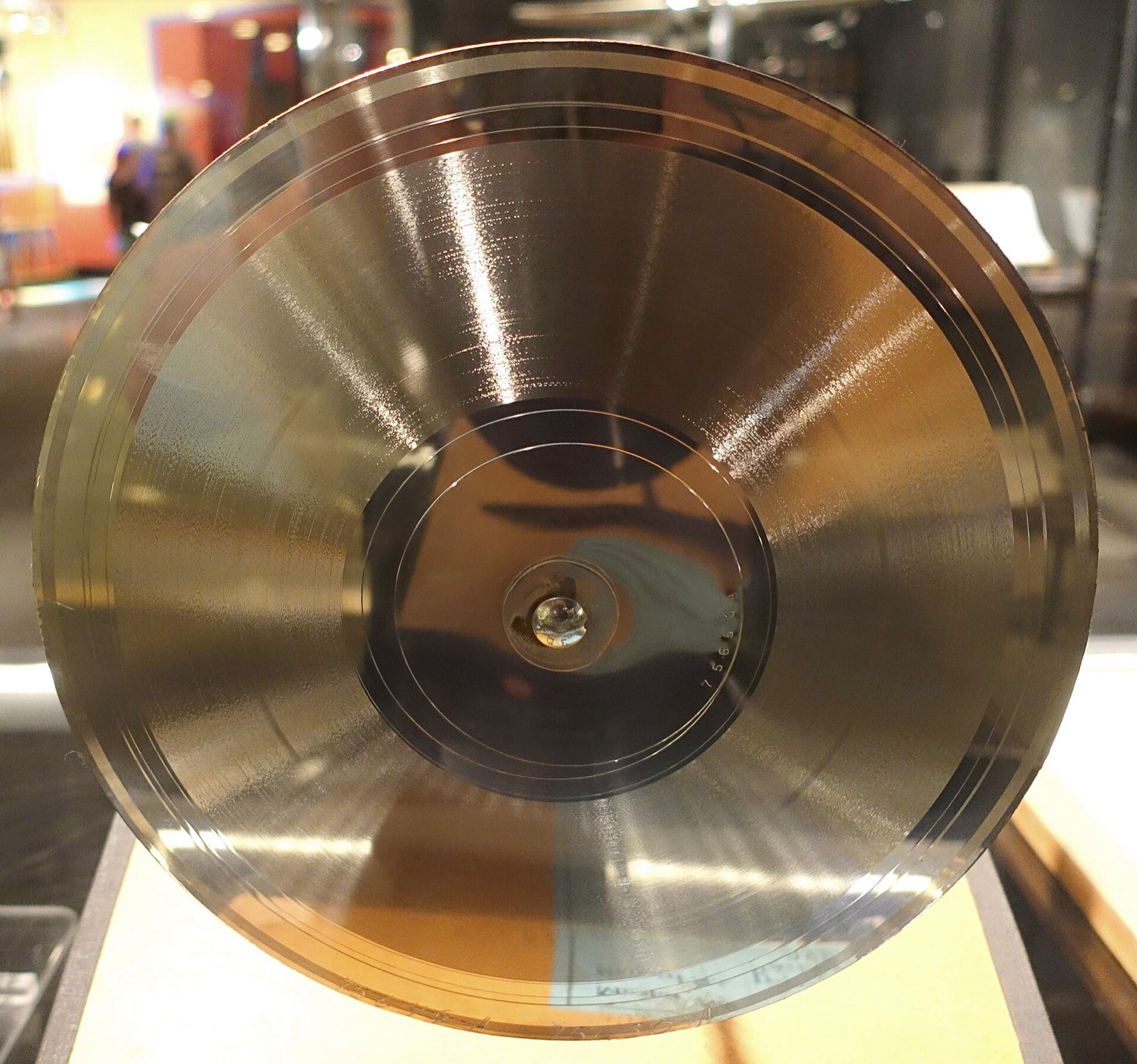
A 1935 metal mother disc, displayed at the Museum of Science and Industry in Chicago. The stampers used for pressing are made from the mother disc; the more they are used, the more they wear.
Both claims have merit, but when it comes to the copy in your hands, it is another matter.
Why it is not necessarily better sounding
You cannot infer from the word "sample" alone that it used better materials, special mastering, or an earlier stamper; all of these require evidence from that specific pressing.
- Stampers vary from record to record. If the promotional record and the first retail pressing used the same stamper, there will be almost no difference in sound. Whether it is an early lacquer cut can sometimes be seen from the end of the matrix number (what Japanese collectors often call "matto 1"), but each record company writes it differently.
- Actual comparisons give mixed results. Saito Koichi compared a US promotional copy of Yes's Fragile with a retail copy; both had the same matrix numbers and pressing plant, and he found the sound identical. When comparing Close to the Edge, the retail copy actually scored higher (5 points) than the promotional copy (4.5 points).
- Promotional records can also be worn out. A promotional record does not mean it has never been played. Some were played repeatedly at radio stations and are heavily worn, in which case a well-preserved retail copy may actually sound better; some also have stamps, stickers, or writing on them.
- What affects the sound most is often the master tape and the lacquer cutting. A comparison on the Japanese website Record Digital Lab found that the US version clearly surpassed the Japanese promotional record in sound pressure and low-frequency stability. Which country and which master tape was used is often more crucial than whether it is a promotional record.
- Without comparison, you cannot know. FACE RECORDS also writes that if you do not have the equipment and ears to discern the difference, you can assume there is almost no difference.
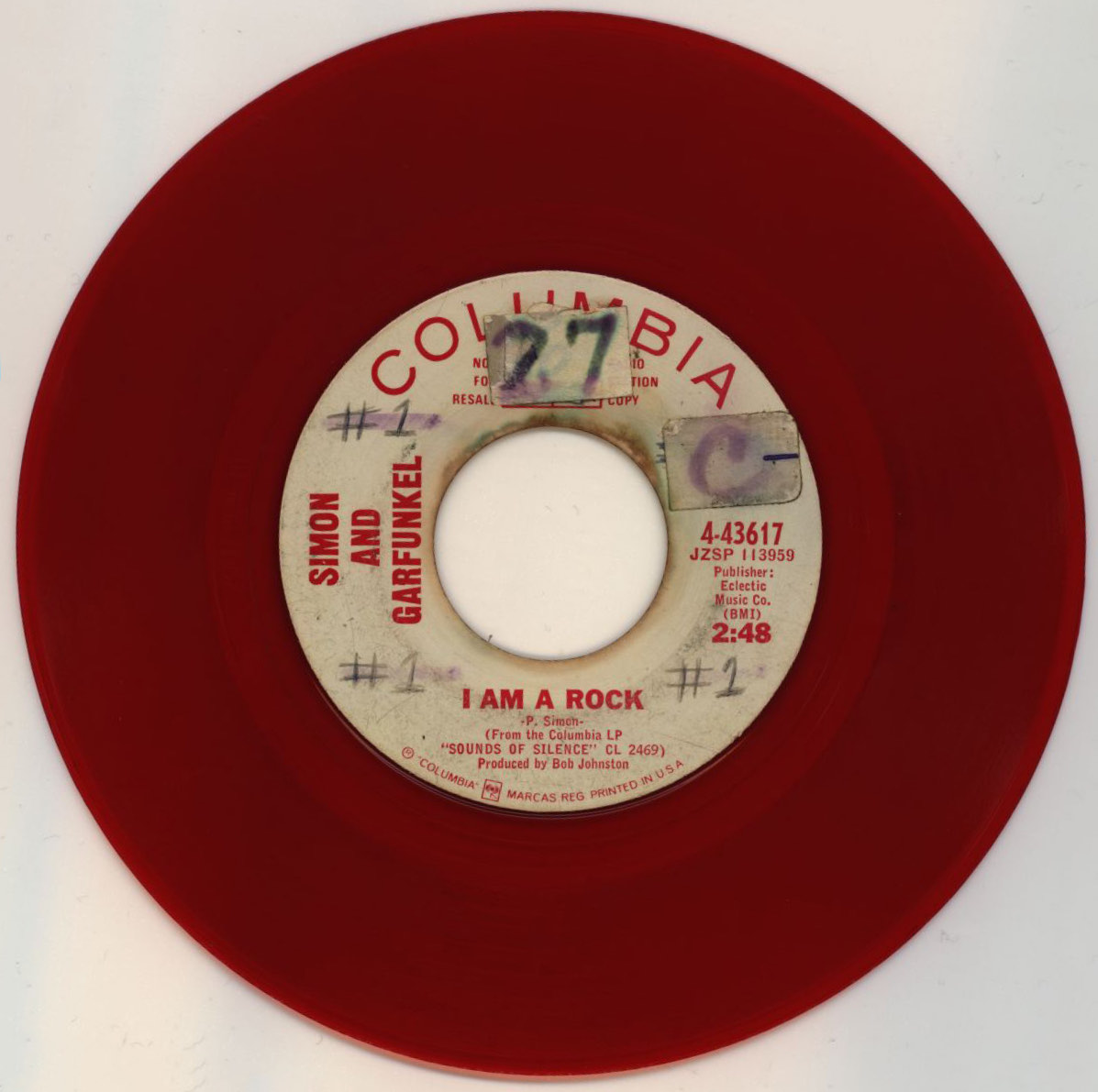
A 1966 US Columbia promotional single, Simon & Garfunkel's "I Am a Rock." The label is worn, has a number sticker, and writing on it, showing it is a used promotional record.
For why Japanese pressings have a good reputation overall and where the sound quality differences lie, see Why Japanese Pressings Are Sought After.
How to compare for yourself
- Prepare a promotional record and a retail copy with the same catalog number; you can also borrow them from a store or a friend.
- Take photos of the matrix numbers and stamper marks on both records and compare them. If the engravings are identical, the sound difference mainly comes from the condition of the records.
- Use the same turntable and the same volume, and listen to the same section of the same song.
- Write down the differences you hear and the condition notes separately.
Why are promotional records valuable?
Fewer in number than retail copies
Promotional records were only sent to radio stations, media, and stores, and far fewer were pressed than retail copies, so they are often treated as collectibles (see Wikipedia's "Promotional recording"). However, in Japan, promotional records are actually not rare. On October 7, 2026, I checked sales records from the past 180 days on Yahoo! Auctions Japan: items with "見本盤" in the title sold about 22,000 times, with an average selling price of about 3,800 yen (including CDs and other formats). This shows that the words "promotional record" alone do not guarantee rarity.
Sometimes the content is different
Most promo copies have the same content as retail versions, but there are exceptions, such as radio-edited versions, mono versions, different mixes or masters, or even tracks not available on the retail version.
Seiko Matsuda's 1981 single "風立ちぬ" (composed by Eiichi Ohtaki) is one example: the promotional 7-inch single (CBS/Sony XDSH 93019) is listed as mono on Discogs, while the retail single (07SH 1067) is stereo. Whether it was a separate mix, I haven't found reliable information yet.
Prices Vary Greatly
In that same 180-day sales record, the cheapest sold for just 1 yen, while the most expensive was a Japanese promo copy of David Bowie's "Cat People (Putting Out Fire)" at 667,000 yen. Among the top-priced ones, there were also several Japanese singles marked "Promo Only." Expensive promo copies often combine several factors: popular works, available only as promotional or on special colored vinyl, in good condition, and with an obi strip.
If you're planning to pay more for it, first verify the version, condition, and actual sales records for the same version; the promotional status itself is not a valuation conclusion. For valuation methods, see How to Value Vinyl Records.
When identifying versions, you can also read the Bootleg Vinyl Guide for reference: whether the promotional use and the release are authorized are two separate issues that need to be verified.
Keep These Clues in Your Collection
After using CRATTO to scan the barcode, cover, or look up the catalog number, you still need to compare the candidate versions with the actual item. Finding an album with the same title is only the first step: keep clues like promotional text, matrix numbers, and condition in your collection records, so it's easier to identify next time you organize.
Frequently Asked Questions
Is a promo copy always a first pressing?
Promo copies are pressed before the release date, so they belong to the earliest batch of that version; but "first pressing" usually refers to the earliest release of an album, which is not the same as "the earliest pressed copy of this version." For example, Japanese pressings of Western works are not the first pressing of the country of origin. For the difference between first pressings and reissues, see Vinyl Version Primer.
Are all white-label records promo copies?
No. Test pressings also often use blank white labels, and some promotional records are not white-label. You need to check the text on the label, catalog number, and matrix numbers, and then compare with Discogs version data.
How much is a promo copy generally worth?
Most are worth only a few hundred to a few thousand yen. In Yahoo Auction sales records checked in October 2026, the average was about 3,800 yen; expensive ones are popular works, singles only available as promos, and special colored vinyl, and the specific price depends on the same version and condition.
Final Thoughts
These records that once circulated among radio DJs have now become witnesses to the history of the record industry. Whether you're an audiophile, a collector, or a City Pop fan, promo copies are worth knowing about.
However, I personally still think the music itself is more important than all of this. This history is truly fascinating, so I share it with everyone; as for collecting, leave it to the collectors.
The reward of digging for records isn't necessarily finding an expensive record. Sometimes, just figuring out why the copy in your hands is different is already very interesting.
Image Sources
The photos in this article are from Wikimedia Commons and are used under the licenses indicated for each image.
- DJ at a Sydney radio station, 1949: photo by L. Bartholomew, Australian Consolidated Press archive, State Library of New South Wales · Public domain · Source
- A record shop in Asakusa, 1954: photo by Tanuma Takeyoshi · Public domain · Source
- Red vinyl record pressed by Toshiba: トンケ(サユリスト) · CC BY-SA 4.0 · Source
- Matrix number in the silent run-out groove: W.carter · CC BY-SA 4.0 · Source
- Metal mother record, 1935: Daderot · CC0 · Source
- Promotional single "I Am a Rock": Peter Clericuzio (Absecon 59) · CC BY-SA 3.0 · Source


