
The short answer: 33⅓ RPM comes from Columbia's LP, launched in 1948, which held about 22 minutes of music per side, enough for a symphony without changing discs. 45 RPM comes from the 7-inch single RCA launched in 1949 as its rival format. After a year of format war, the industry settled on LPs for albums and 45s for singles, and 78 RPM faded out during the 1950s. Here is how that speed war played out.
A couple of days ago, while playing a record, I noticed that on the turntable, next to the default 33 RPM button, there was a 45 RPM button that almost never gets pressed. This sparked an obsession with these two numbers, and I wanted to investigate further, which led to today's story.
The content of this story is sourced from the internet, books, and other information sources. If there are any inaccuracies, corrections in the comments are welcome.
From the Great Depression to Postwar Technological Innovation
In the autumn of 1945, the smoke of battle in Europe was slowly dissipating, and on the ruins of war, a new world order was gradually being reconstructed.
Hungarian-born engineer Peter Carl Goldmark, the genius engineer who invented color television, was conducting an experiment at the Columbia Records headquarters in Manhattan—an experiment that would soon change the entire music industry.
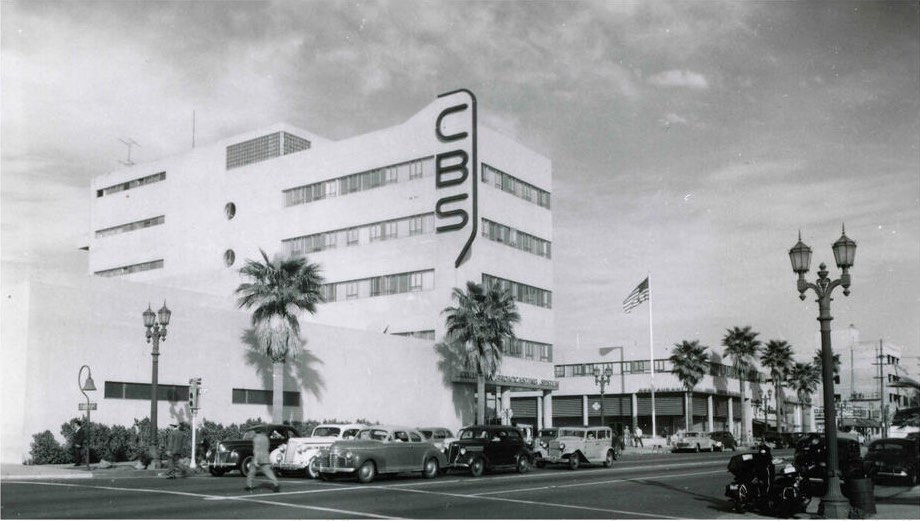
Goldmark was facing a seemingly simple yet extremely tricky challenge: how to make a record play an entire symphony continuously, instead of like the existing 78 RPM shellac records, which required getting up to change the disc every four minutes?
This problem had long plagued the entire classical music world. Imagine if in the 1940s you wanted to listen to Beethoven's Ninth Symphony. You would need to prepare seven heavy 78 RPM records, and each could only hold less than five minutes of music.
When you are immersed in the world of music, suddenly at the climax of a movement, the music abruptly stops, and the stylus traces the last groove, emitting a harsh noise. It's as if you are awakened from a sweet dream, and you have no choice but to stand up helplessly, carefully pick up that extremely fragile shellac on the turntable, then find the next one from your record rack, align it with the spindle, lower the stylus, and the music continues. But I think although the music continues, your "sweet dream" is hard to re-enter; the dream is interrupted, and the emotional experience slowly built by the music is shattered.
But this was not a technological blank. In fact, as early as 1931, RCA Victor had introduced 33 1/3 RPM "program transcription records" for radio stations. That was a technically advanced attempt, but it was a commercial disaster.
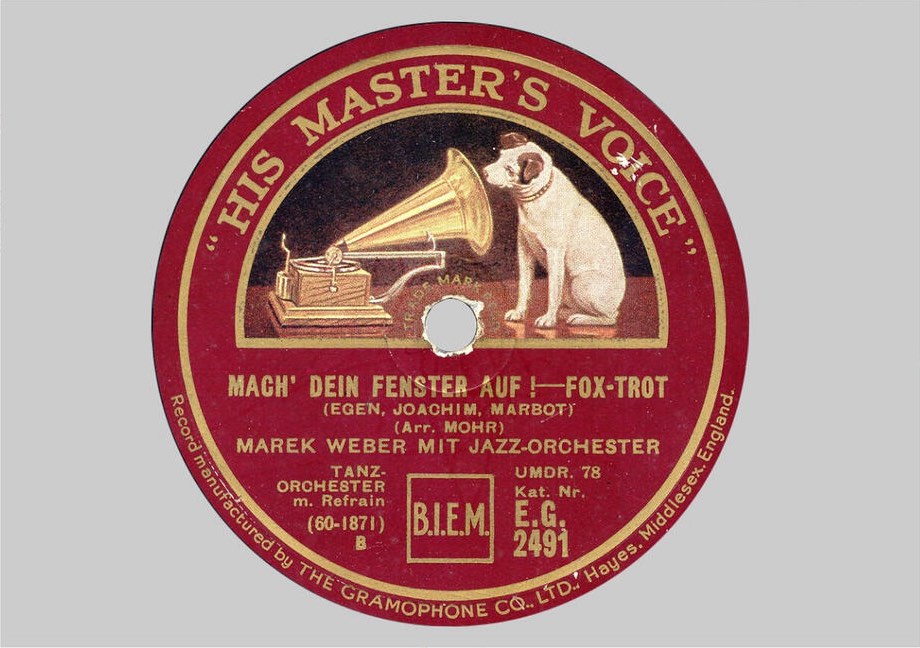
But RCA's failure cannot be entirely blamed on their technical capability; the main reason is that this attempt was made at the wrong time. In the 1930s, the United States was experiencing the Great Depression, with 13 million unemployed. In 1932, 34 million people lived in families without a fixed full-time income. Consumers could hardly afford food, let alone spend money on expensive new playback equipment.
Of course, the technology in 1931 was far from mature, with rough sound quality and unbearable surface noise. RCA's failure made the entire industry wary of long-playing records, and for fifteen years no one dared to touch this field again.
But the world of 1945 was completely different. Although the war had left the world unrecognizable and scarred, the technological progress driven by the war was unprecedented. These technologies, evolved due to the war, brought new possibilities for technological and industrial innovation in many industries, including the record industry.
Synthetic material polyvinyl chloride (PVC) developed by the military industry was far tougher and more durable than shellac; precision engineering technology from radar and sonar research could manufacture extremely fine recording equipment; more importantly, by then the United States had emerged from the depression, and the wartime dividends brought unprecedented prosperity, with the rise of the middle class and explosive growth in demand for cultural consumption. The time for technological innovation in the record industry had matured.
The core challenge facing Goldmark came from the laws of physics. The playing time of a record depends on three variables: record diameter, rotation speed, and groove density. 78 RPM records could only cut about 80-100 grooves per inch, which was the limit of shellac material and stylus technology at the time. To accommodate more than 20 minutes of music on a 12-inch record, breakthroughs had to be achieved simultaneously in three dimensions: reducing rotation speed to extend playing time, increasing groove density to fully utilize surface area, and ensuring sound quality improved rather than declined.
In the winter of 1946, the United Nations General Assembly voted to locate its permanent headquarters in New York City, a decision that would have a profound impact on the city. Around the same time, Goldmark's experiment reached a historic turning point. By using PVC material and a brand-new "microgroove" cutting technology, engineers increased groove density to 224-260 grooves per inch—nearly three times that of 78 RPM records. The new stylus required only 6 grams of tracking force (instead of 25 grams for 78 RPM records), greatly reducing wear. The slow rotation of 33 1/3 RPM combined with microgroove density meant that on a 12-inch record, the stylus had to travel nearly half a mile of grooves to complete one side—an engineering miracle.
By the summer of 1947, when the first test LP was played in the laboratory, the engineers present held their breath. The first movement of Beethoven's Fifth Symphony flowed out, with clear sound quality and almost imperceptible surface noise. 7 minutes... 10 minutes... 15 minutes... the music did not stop. When the last note disappeared into silence, the laboratory erupted in cheers—the music industry was about to undergo a revolution.
Although no one could foresee it at the time, this revolution would trigger a two-year commercial war that would ultimately reshape the pop culture of the entire second half of the 20th century.
June 18, 1948: Mendelssohn's Violin Concerto in E Minor and Columbia's Historic Leap
The ballroom of the Waldorf-Astoria Hotel in New York has always been a stage for power and wealth, but on June 18, 1948, it became a witness to a technological revolution. Columbia Records held a press conference here to showcase to gathered journalists, music critics, and industry executives an invention that would "change the history of music."
In the center of the hall, a new type of record player waited quietly. Columbia President Edward Wallerstein stepped onto the podium, behind him a stack of 78 rpm records eight feet high. Standing beside the eight-foot-tall pile of 78s, he held a stack of new long-playing records and announced: "Gentlemen, the amount of music contained in these records in my hand is equivalent to that enormous pile of 78s." The dramatic contrast stunned the entire room.
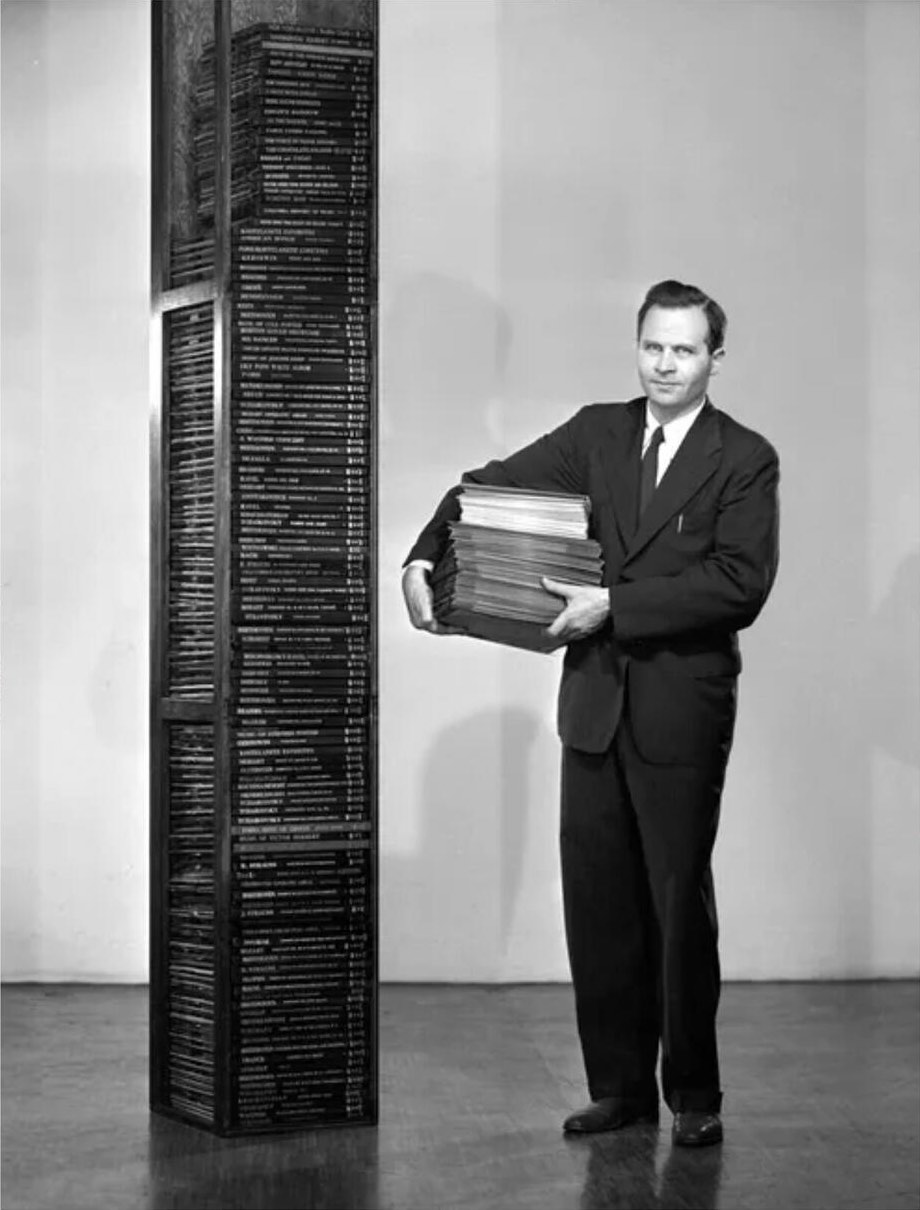
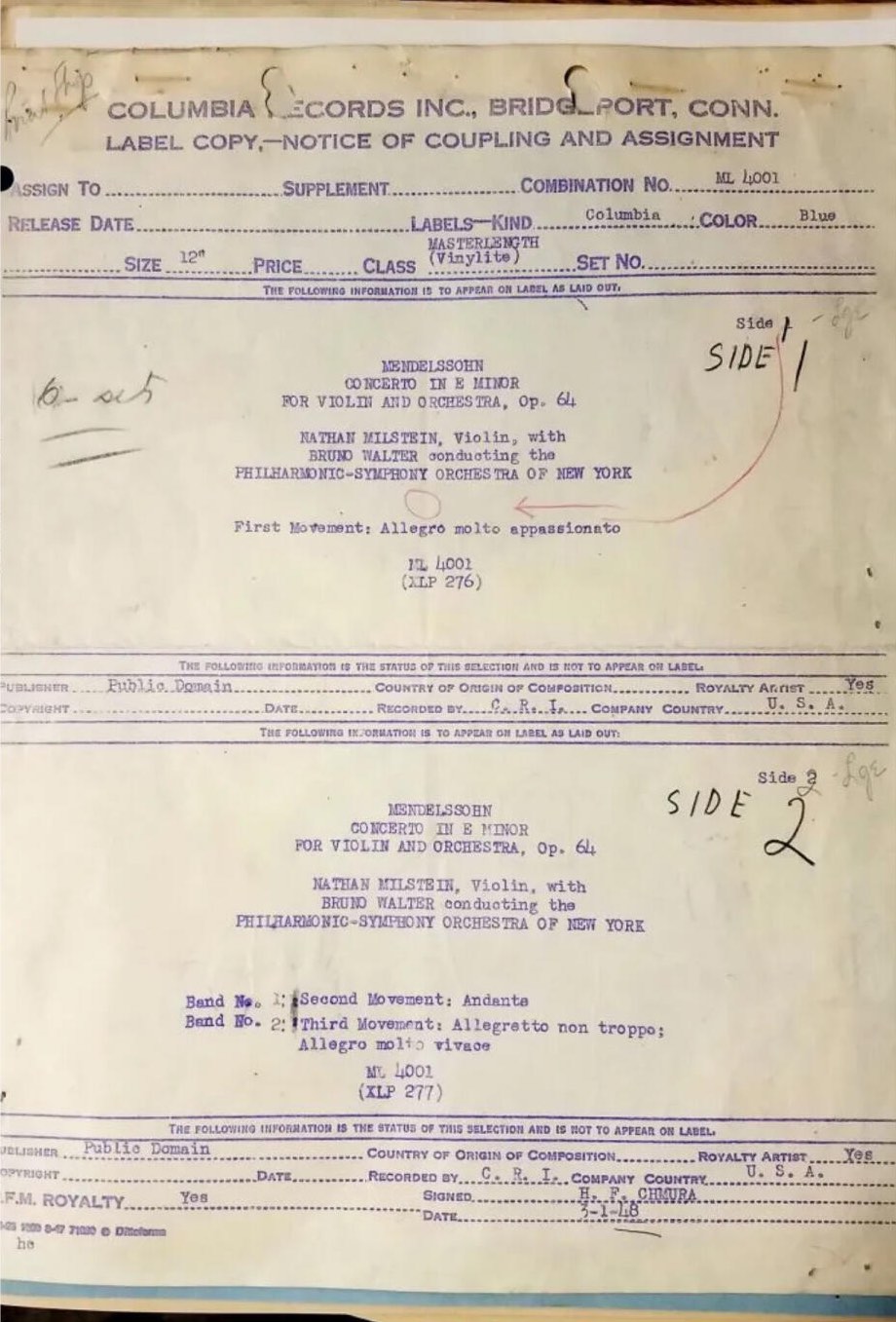
The first long-playing record catalog was released the same day. Led by Mendelssohn's Concerto in E minor (catalog number ML 4001) performed by Nathan Milstein with Bruno Walter conducting the New York Philharmonic, this catalog of 101 records consisted mainly of classical works. (The image below shows the label document for the first LP: a recording of Mendelssohn's Violin Concerto performed by the New York Philharmonic, from the Columbia Records Label Documents Collection, Box 121, Folder 3.)
This choice was no accident—the classical music market was the natural home for the LP, as these listeners best understood the value of continuous playback and were most willing to pay a premium for a high-quality musical experience.
Price positioning reflected Columbia's market strategy: 12-inch LPs sold for $4.85, 10-inch LPs for $2.85, while 78 rpm record sets with equivalent content could cost $6-7.
The LP not only offered a better experience but was also more economical. This was a classic disruptive innovation pricing strategy, half a century before Christensen proposed the concept of "disruptive innovation" in The Innovator's Dilemma in 1997.
After the stunning effect at the launch, Columbia made the unprecedented announcement that it would open LP technology to all record companies, free of patent fees.
From the consumer's perspective, this was a rather generous move, but from a business perspective, only if the entire industry adopted the same technical standard would Columbia become a true standard-setter and thus capture the largest market share.
Columbia's launch and market strategy were thriving, but at RCA Victor headquarters on the south side of Central Park in Manhattan, a giant that had evolved from Berliner's American Gramophone Company (I'll write about that later if I get the chance), anger, humiliation, and a determination never to concede filled the air. A standards war was brewing.
RCA's Arrogance: The Forced Birth of 45 rpm!
If Columbia's LP was a technological innovation carefully cultivated based on real consumer market problems, then RCA's 45 rpm single was a reluctant response to market competition.
In fact, when Columbia began secretly developing the LP in 1945, it tentatively invited RCA to jointly develop an industry standard. But RCA's arrogance killed any possibility of cooperation.
Given the precedent of Edison's early long-playing record schemes, which had applied for multiple patents but all failed, Columbia decided not to patent the LP and hoped that RCA Victor would also adopt the format and jointly establish it as a new industry standard.
But RCA chief David Sarnoff—a radio pioneer who had been involved in Titanic telegraph operations—was furious: tiny "Columbia" dared to propose that RCA Victor, the inventor of radio and the 78 rpm record, endorse a competitor's innovation. It is said that in front of Wallerstein he angrily berated his subordinates, demanding why they had not come up with the LP idea first, and ordered them to develop a superior technology.
RCA's reaction is easy to understand. As America's largest record company and electrical manufacturer, RCA Victor held dominant position in the recording industry in the 1940s. It had the most top artists, from classical master Artur Rubinstein to pop idol Perry Como;
Its manufacturing plants were the largest and most advanced; its parent company RCA was a giant in radio, television, and audio equipment. It was this dominance that led RCA executives to dismiss Columbia's proposal—why share future standard-setting power with a competitor? RCA believed that with its own technological strength and market control, it could independently develop a superior system.
But history did not obey the will of RCA executives. When RCA was publicly humiliated by Columbia on June 18, 1948, even more humiliating was that they soon discovered that some of the inspiration for Columbia's new technology actually came from RCA's failed long-playing record of 1931. It was truly a case of being overshadowed by a rival standing on their shoulders! RCA's top management held an emergency meeting, and President David Sarnoff issued a clear order: RCA must launch its own new-generation record format within six months, and it must surpass Columbia technologically.
RCA's engineering team faced a difficult choice. They could simply adopt Columbia's 33 1/3 rpm standard (Columbia had already opened its patents), but that would be an admission of defeat. They had to develop a differentiated format while proving RCA's technological superiority. After months of intensive experimentation, a radical plan emerged: completely abandon the album market and focus on singles—the most profitable and highest-selling segment.
The potential of the singles market had already become apparent in the late 1940s. The teenage group was emerging as independent consumers; they had no patience to listen to an entire album and only wanted the hottest songs of the moment. The jukebox industry was booming, with these automatic playback devices installed in every restaurant, bar, and ice cream parlor. Singles cost less than $1, making them the easiest impulse purchase. If RCA could dominate this market, even if it lost the album field, it could maintain industry leadership.
In January 1949, at an engineers' conference, RCA presented their answer: a new type of single record that was 7 inches, 45 RPM, with a large center hole. Every parameter of this design was precisely calculated.
How was the 45 RPM speed determined?
Some claim that the 45 RPM record speed was derived by subtracting 33 from 78, just to make RCA deliberately go against Columbia, but this is not true.
RCA's engineers discovered that on a 7-inch diameter record, 45 RPM is a magic number—at this speed, the groove diameter of the innermost circle is exactly half of the outermost circle, meaning that from start to finish, the stylus moves at a relatively constant linear speed, maintaining consistent sound quality. The faster speed (compared to 33 1/3) also means better high-frequency response and lower distortion.
The large center hole design (1.5 inches in diameter, rather than the LP's 0.286 inches) was even more genius. This seemingly wasteful design was actually aimed at the jukebox industry: the large hole allowed the mechanical arm to quickly and accurately grab and place records, enabling automatic record changing. RCA even designed a special plastic adapter so that large-hole records could also be played on standard turntables.
In February 1949, RCA launched a massive nationwide marketing campaign. They claimed that 45 RPM singles "sound better than any existing format" and introduced a small player priced at only $12.95—a disruptive price point that was highly competitive compared to the LP player's $29.95. RCA used its massive manufacturing capacity to quickly press millions of 45 RPM records, covering all genres from pop, country to R&B.
But RCA made a fatal strategic mistake: they refused to produce the LP format, insisting on releasing only 45 RPM and the old 78 RPM records. This decision still stemmed from RCA's arrogance, believing that consumers would be forced to choose RCA's standard. Reality quickly gave a cruel answer.
1949-1950, the Charge of the Speed War! Let's Fight!
From the spring of 1949 to the winter of 1950, this short one-year period can be said to be the most chaotic year in American record history. Walking into any record store, one would see a dazzling scene: the same song might be available simultaneously in 78 RPM, 45 RPM, and 33 RPM versions; the same album might appear as a 10-inch LP, 12-inch LP, or 78 RPM set!
Worse still, this competition evolved from record formats to all-out competition, eventually extending to equipment, with music released by different companies using different formats. Want to listen to artists under Columbia? You need an LP player.
Prefer RCA's singers? Sorry! You can only buy 45 RPM, although some turntables are equipped with spindle size adapters, other models require the snap-on adapter shown below to adapt RCA's larger 45 RPM spindle to the smaller spindle specifications equipped on almost all turntables.

This "Battle of the Speeds" became a classic case in industry standards and business history, demonstrating how standard competition can harm an entire industry.
Consumer confusion led to a wait-and-see attitude spreading, with consumers hesitant to buy, "Why invest in expensive equipment if this format might be obsolete in a few months?"
Retailers also suffered, having to stock inventory of three speeds, occupying large amounts of capital and shelf space. Small record companies were caught in a dilemma, not wanting to offend Columbia nor ignore RCA's market power, and could only release multiple versions simultaneously, with high costs.
Media coverage of this war shifted from initial excitement to sarcasm and criticism.
But the invisible hand of the market would guide consumers to vote with their wallets, and they voted for different destinies for the two formats. Classical music enthusiasts, serious music listeners, and adult middle-class consumers clearly preferred the LP—they were willing to pay a higher price for a complete listening experience, valuing continuous playback and high-quality sound. Teenagers, casual buyers, and jukebox operators favored 45 RPM—cheap, portable, and meeting instant entertainment needs.
By the end of 1949, market data began to show a divided landscape: LP dominated the album market, 45 RPM was unstoppable in the single market, and although 78 RPM still held the largest share (mainly due to inertia and compatibility), it was clearly entering a decline, as the saying goes, "It's not about you when it's time to eliminate you."
In this competition, some neutral observers pointed out the obvious fact: these two formats were not substitutes for each other but complementary—they served different demand scenarios.
Divisions also began to appear within RCA. Sales department reports showed that many consumers inquired about RCA's LP albums, while the company could only watch as these potential customers turned to Columbia or other labels that had started releasing LPs. More embarrassingly, RCA's classical music artists—the company's once proudest asset—began to complain that their recordings could only be released on 78 RPM multi-disc sets, while competitors' works already enjoyed the advantages of LP.
In January 1950, RCA made a difficult but necessary decision: to start releasing the LP format. But RCA's pride did not allow the market to see this decision as a surrender to Columbia, so the decision was carefully packaged. RCA claimed it was to provide consumers with maximum choice, emphasizing that the company would support both "high-fidelity" formats simultaneously. But it was clear to all: the speed war was effectively over, and this seemingly life-and-death zero-sum game ultimately reached a delicate balance, with each side occupying its own territory, continuing the game.
Later, in February 1951, Columbia announced it would start releasing 45 RPM singles. Similarly proud, it stated this was to meet all consumer needs, but in essence, it acknowledged RCA's success in the single market. This decision marked an informal but effective industry consensus: LP for albums, 45 RPM for singles, and also silently declared that 78 RPM would gradually exit the stage of history.
In 1954, RCA announced it would stop producing 78 rpm players, marking the decline of the 78 rpm record. Although industry statistics from 1952 showed that 78 rpm still held 50% of the market share, this trend was irreversible. The 78 rpm record was like a frail old man, accepting the fate history had given him. The format that had ruled the recording industry for half a century officially entered its twilight. By the late 1950s, 78 rpm had essentially disappeared from the market, surviving only in some remote areas or among nostalgic collectors.
Meanwhile, the fate of the 10-inch LP was also sealed. This size, initially regarded as the standard for popular music, quickly proved to be a transitional compromise. Consumers found that the extra capacity and sound quality offered by the 12-inch LP were worth the slightly higher price, while the 10-inch LP was neither as capacious as the 12-inch nor as portable and cheap as the 45 rpm. After 1954, major record companies gradually stopped releasing new 10-inch LPs, and by October 1956, the last batch of 10-inch LPs was removed from catalogs. From then on, 12 inches became the sole standard size for albums.
Technological standardization further consolidated the new order. In 1954, the Recording Industry Association of America (RIAA) published the equalization curve standard, unifying the frequency response specifications for recording and playback. This meant that any brand of player could accurately reproduce the sound of any record, eliminating the compatibility issues left over from the format war.
In 1957-1958, stereo recording technology was commercialized, using the 45/45 groove cutting method, with left and right channel information recorded on the two walls of the groove respectively. This technological breakthrough further expanded the advantages of the LP—the spatial sense created by stereo became more enchanting during long listening sessions.
At this point, the speed numbers on our turntables have basically settled on the two numbers: 33 and 45.
Final Thoughts
In a previous article, I mentioned Marshall McLuhan's classic work "Understanding Media," which proposed that the medium is the message, and that the medium itself shapes human behavior in turn. The speed war perfectly explains this theory. The speed war was far more than a simple format switch; changes in media profoundly reshape the creation, distribution, and consumption of music. LP and 45 rpm singles are not just carriers of music; they actually defined what music could become, and this influence is still clearly visible today!
The LP's 22-minute single-side capacity was not a number plucked from thin air, but a limitation imposed by the laws of physics. But this limitation, in turn, became a creative framework: musicians learned to build narratives within 22 minutes, controlling tension and release. The LP format also drove the development of the bebop and post-bop jazz movements, allowing musicians to fully express themselves in long improvisations and solos.
Similarly, the 5-minute capacity of the 45 rpm single gave rise to the golden rule of pop music: 3 minutes is the ideal length. This was not because of artistic considerations, but because a 3-minute song could fit perfectly on a 45 rpm record. In the 1960s, artists who wanted their songs played on the radio or jukebox had to ensure their works could be included on a single record. This rule was simple and cruel—an overly long work meant losing the chance to be played, and naturally cutting off any possibility of becoming popular.
Even in the digital age, when physical limitations have disappeared, 3-4 minutes remains the mainstream length for pop songs—cultural inertia perpetuates the traces left by technological constraints.
The system spawned by the speed war would dominate the music industry for nearly 30 years, until the advent of the CD in the 1980s. But even in the digital age, the LP and the single as basic types of music products still exist. The legacy of the speed war continues to shape the way we consume music today.
Today, as we witness the revival of vinyl records in the digital age, this story seems to take on new meaning.
Most vinyl buyers in the 2020s have streaming subscriptions and can instantly access millions of songs. But that doesn't stop them from buying vinyl records, including me. I think there are functional considerations for buying vinyl, but I believe it's not entirely that. Vinyl is inferior to digital music by almost all objective standards. But buying vinyl gives listeners a new experience, a new relationship with music in the digital age (a more active relationship), and a belief in material authenticity.